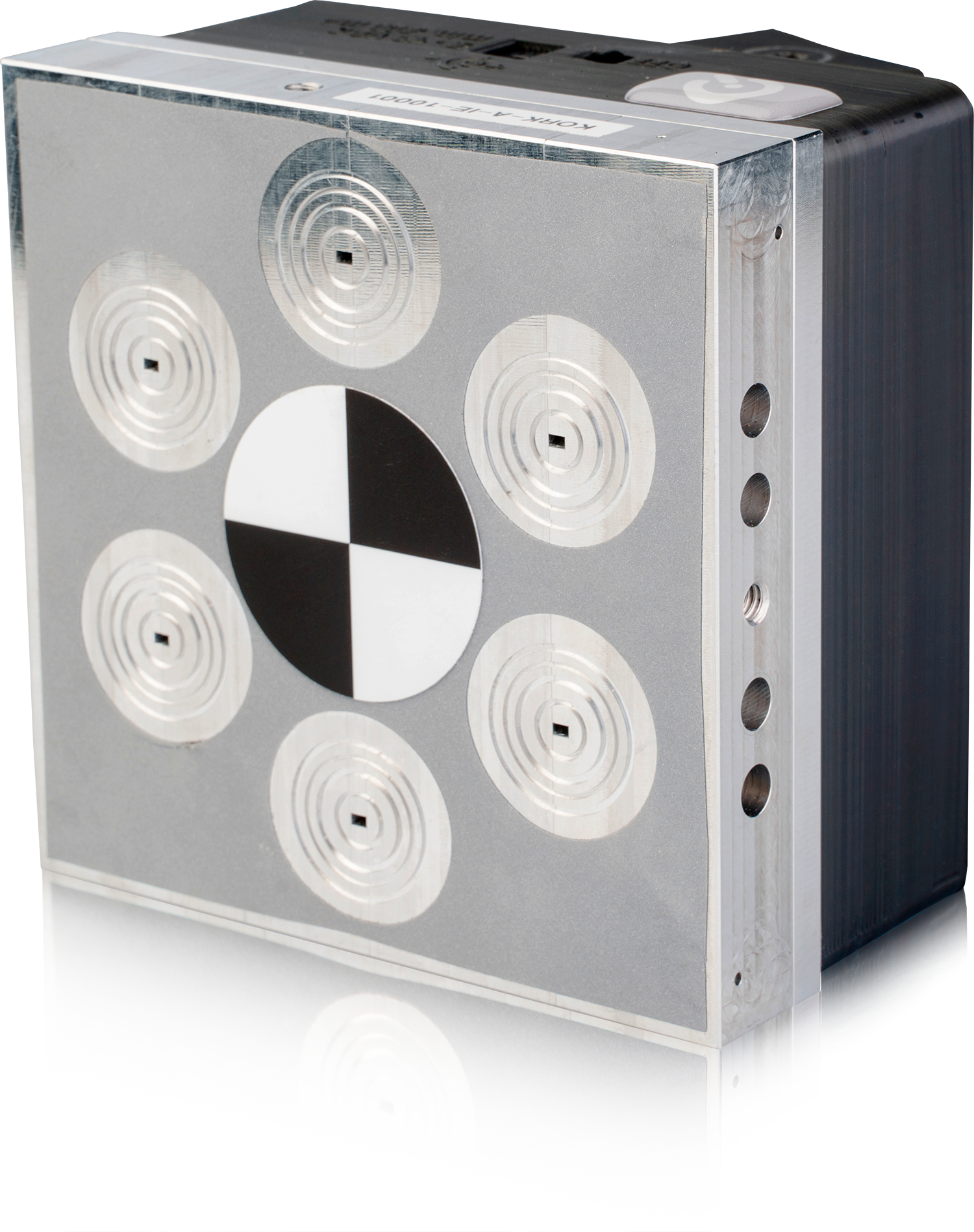
KORK introduces an active radar retroreflector combined with a visible optical marker to enable alignment of visual cameras and radar.
The optical marker indicates the center of the reflector surface and corresponds to the radar signal's reflection point. Due to the reflector's planarity, the reflection center and the optical marker lie in the same plane, avoiding angular errors when aligning two or more sensor systems (conventional trihedral corner reflectors introduce angular errors because of their physical depth, which allows multiple reflections of an incoming radar wave). Furthermore, KORK is equipped with a retroreflective file to drastically increase Lidar-Systems' visibility.
Precise spatial alignment between radar and camera sensors, or between individual sensors, can then be analyzed. In addition, sensor alignment verification (e.g., for online algorithms) is enabled by active radar reflector solutions. This concept is beneficial for sensor development and EoL (end-of-line) testing.
KORK's versatile design allows it to be integrated into a test laboratory or onto a production line. Typically, a car or the device under test is placed directly in front of the KORK for calibration* and characterization. Depending on the environment, radar absorbers may need to be distributed on and around the holder to reduce unwanted radar reflections.
For an ideal testing environment, we recommend using multiple KORK devices to more efficiently cover all degrees of freedom. All tests can be performed with a single KORK device, but additional setup adjustments are required during testing. Our support team can assist you in recommending an ideal setup for your needs.
*Please note that KORK is not a ready-made calibration solution but only the hardware to create a custom solution in a test lab or production line.