Mobile Phone Cameras

    Mobile Phone Cameras
    Objective Image Quality Testing

    Independent, score-based characterization of smartphone cameras, main, selfie, ultra-wide and zoom, stills and video, measured the way people actually shoot, and expressed as a single number that tracks real user perception.

    Overview

    The smartphone is the camera most people use most of the time. For manufacturers, image quality has become a headline feature and a fiercely competitive battleground, yet "good image quality" is notoriously hard to communicate and even harder to compare fairly. Sensor megapixels and aperture numbers say little about how a phone will actually photograph a child's birthday party or a city street at night.

    That is the gap standardized testing fills: a transparent, repeatable way to measure what a camera really delivers across the use cases that matter to users, and to express it as a single, comparable score. Image Engineering's mission has always been to give our customers objective, reproducible results when evaluating their camera systems, and the VCX Forum shares that goal for mobile and webcam imaging, so that the score reflects genuine user experience rather than any single tester's opinion.

    Our iQ-Lab is a trusted VCX-PhoneCam test lab. We evaluate smartphone cameras to the VCX Score, the modern, user-correlated benchmark from the VCX Forum, and can also support the IEEE Std 1858-2023 (CPIQ) framework where a project calls for it. Whether you are tuning an image signal processor, validating a new sensor module, or benchmarking against the competition, we deliver objective image quality data your team can act on.

    Let the iQ-Lab score your camera

    A spec sheet cannot tell a buyer how a phone will photograph the people and places they care about, a VCX result can. It condenses dozens of measured image quality factors into a single, objective value, calibrated against large-scale studies of real users and produced with no human judgment in the scoring. The result is reproducible and independent of the lab or tester, so you can genuinely compare it device to device and version to version.

    Our iQ-Lab is set up to the VCX white paper specification and runs the full VCX-PhoneCam test program, main, selfie, ultra-wide and zoom cameras, across stills and video, under controlled, reproducible conditions. As a trusted VCX lab, we also run validation tests that help the VCX Forum develop future versions of the standard, so your testing stays aligned with where the benchmark is heading.

    Independent and objective: a neutral third-party result, free of vendor bias, that holds up in front of customers and management alike.

    Real-world conditions: bright, indoor and low-light scenes, plus motion, zoom and video, matched to how phones are actually used.

    Development-ready data: per-factor sub-scores and clear documentation your engineering team can act on, not just a headline number.

    What we Measure for Mobile Camera Testing

    Every VCX result breaks down into the individual image quality factors and performance behaviors behind the final score.

    Resolution & Texture

    SFR · ISO 12233

    Spatial frequency response captures how much fine detail the camera resolves, while texture analysis reveals how aggressively noise reduction smears away low-contrast structures such as hair, foliage and fabric.

    Visual Noise

    Noise · ISO 15739

    Noise is measured in both the luminance and color channels and weighted for how the human eye perceives it, the difference between a clean low-light shot and a grainy one.

    Color & White Balance

    Color · ISO/CIE 11664

    Color accuracy and automatic white balance are assessed across a range of illuminants, with particular attention to natural, pleasing skin tones.

    Dynamic Range & Exposure

    OECF · ISO 14524

    High-contrast scenes test whether the camera holds detail in both deep shadows and bright highlights, and whether auto-exposure lands the overall brightness where a viewer expects it.

    Low-Light Performance

    Low light · ISO 19093

    An extended low-light procedure captures the scene at progressively dimmer levels to find the point at which image quality can no longer keep up, a decisive factor for everyday users.

    Timing & Stabilization

    Image stabilization performance · ISO 20954

    Performance testing covers autofocus speed, frame-rate consistency in video, and image stabilization measured against a simulated, true-to-life handshake.

    International Standards relevant to Mobile Phone Imaging

    What We Measure for Mobile Camera Testing

    We lead with the modern, user-correlated VCX Score, and support the established CPIQ framework and its underlying ISO methods where a project requires them.

    VCX PhoneCam

    Our recommended benchmark. A single objective score, calibrated against large-scale user studies and continuously updated to cover today's use cases, selfie video, ultra-wide and zoom included. We are a trusted VCX-PhoneCam lab.

    IEEE Std 1858-2023 (CPIQ)

    The Camera Phone Image Quality standard defines objective and subjective methods for mobile-device image quality, spatial frequency response, visual noise, texture blur, color and local geometric distortion. We support CPIQ-based evaluation on request.

    Underlying ISO Methods

    The factor-level measurements draw on established ISO methods, including ISO 12233 (resolution / SFR), ISO 15739 (noise), ISO 19093 (low-light) and ISO 20954 (image stabilization).

    Prefer to Test In-House?

    If you would rather run mobile camera testing on your own bench, we supply the same standard compliant charts, illumination and analysis tools our iQ-Lab uses. The full product line is introduced on our Industries & Products pages.

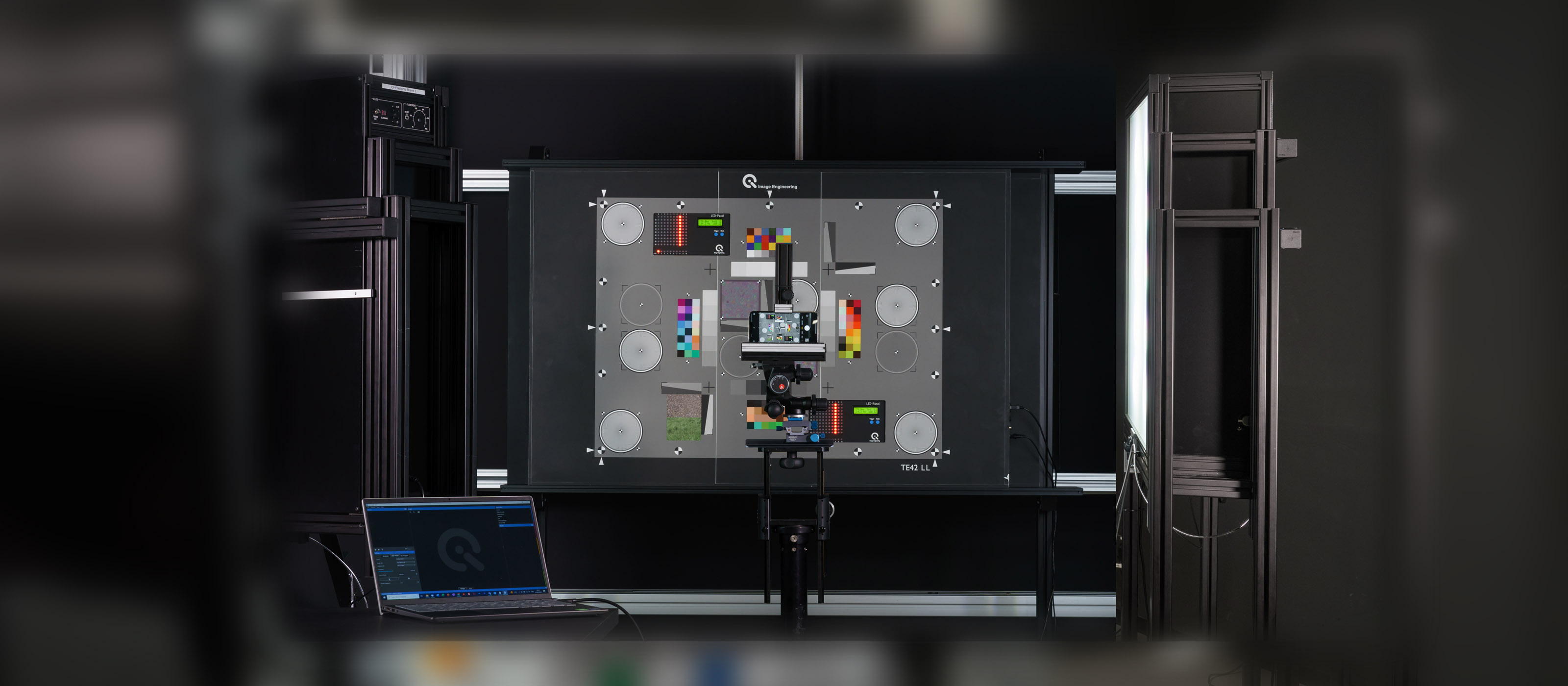
    TE42-LL Test Chart

    The multipurpose chart at the heart of VCX still and video testing, combining resolution, texture, color and timing structures in one target.

    iQ-Flatlight

    LED illumination based on iQ-LED technology, generating the custom spectra and controlled light levels VCX requires for repeatable conditions

    LE7 & TE269

    A uniform LED lightbox paired with a transparent grayscale step chart for high-contrast dynamic range measurements.

    STEVE & iQ-Near Focus

    Stabilization Evaluation Equipment for true-to-life handshake simulation, plus the iQ-Near Focus trigger for objective autofocus and timing tests.

    iQ-Analyzer-X

    §The analysis software that turns captured test images into the objective KPIs behind every VCX result.